|
|
The city 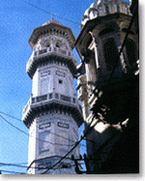 (capital of the province) lies just west of the Bara River, a
tributary of the Kabul River, near the Khyber Pass. The Shahji-ki
Dheri mounds, situated to the east, cover ruins of the largest
Buddhist stupa in the subcontinent (2nd century AD), which attest
the lengthy association of the town with Buddha and the religion
founded about him. Once the capital of the ancient Buddhist
kingdom of Gandhara, the city was known variously as Parasawara
and Purusapura (town, or abode, of Purusa). Also called Begram,
the present name, Peshawar (pesh awar, “frontier town”), is
ascribed to Akbar, the Mughal emperor of India (1556–1605). A
great historic centre of transit-caravan trade with Afghanistan
and Central Asia, Peshawar is today connected by the Grand Trunk
Road and rail with Lahore, Rawalpindi, Hyderabad, and Karachi
and by air with Rawalpindi, Chitral, and Kabul, Afg.
Industries include textile and sugar mills, fruit canning, and
the manufacture of chappals (sandals), shoes, leatherwork, glazed
pottery, wax and embroidery work, copper utensils, lungis (loincloths)
, turbans, carpets, ornamental woodwork and furniture, ivory work,
knives, and small arms. The ancient Qissah (Kissa) Khwani Bazar
(“Street of Storytellers”) is the meeting place for foreign merchants
who deal in dried fruits, woolen products, rugs, carpets, pustins
(sheepskin coats), karakul (lambskin) caps, and Chitrali cloaks.
(capital of the province) lies just west of the Bara River, a
tributary of the Kabul River, near the Khyber Pass. The Shahji-ki
Dheri mounds, situated to the east, cover ruins of the largest
Buddhist stupa in the subcontinent (2nd century AD), which attest
the lengthy association of the town with Buddha and the religion
founded about him. Once the capital of the ancient Buddhist
kingdom of Gandhara, the city was known variously as Parasawara
and Purusapura (town, or abode, of Purusa). Also called Begram,
the present name, Peshawar (pesh awar, “frontier town”), is
ascribed to Akbar, the Mughal emperor of India (1556–1605). A
great historic centre of transit-caravan trade with Afghanistan
and Central Asia, Peshawar is today connected by the Grand Trunk
Road and rail with Lahore, Rawalpindi, Hyderabad, and Karachi
and by air with Rawalpindi, Chitral, and Kabul, Afg.
Industries include textile and sugar mills, fruit canning, and
the manufacture of chappals (sandals), shoes, leatherwork, glazed
pottery, wax and embroidery work, copper utensils, lungis (loincloths)
, turbans, carpets, ornamental woodwork and furniture, ivory work,
knives, and small arms. The ancient Qissah (Kissa) Khwani Bazar
(“Street of Storytellers”) is the meeting place for foreign merchants
who deal in dried fruits, woolen products, rugs, carpets, pustins
(sheepskin coats), karakul (lambskin) caps, and Chitrali cloaks.
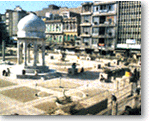
Peshawar's historic buildings include Bala Hissar, a fort built by
the Sikhs on the ruins of the state residence of the Durranis, which
was destroyed by them after the battle of Nowshera; Gor Khatri, once
a Buddhist monastery and later a sacred Hindu temple, which stands
on an eminence in the east and affords a panoramic view of the entire
city; the pure white mosque of Mahabat Khan (1630), a remarkable
monument of Mughal architecture; Victoria memorial hall; and Government
House. There are many parks, and the Chowk Yadgar and the town hall
are other places of social and public assembly. Coffeehouses also are
popular. Gardens and suburbs are outside the old city wall.
References to the Peshawar area occur in early Sanskrit literature and
the writings of the classical historians Strabo and Arrian and the
geographer Ptolemy. The Vale of Peshawar was annexed by the Greco-Bactrian
king Eucratides (2nd century BC), and Kaniska made Purusapura the capital
of his Kushan (Kusana) empire (1st century AD). Buddhism was still dominant
in the 5th century AD when Fa-hsien, the Chinese Buddhist monk and
traveler, passed through the area. Captured by the Muslims in AD 988,
it was by the 16th century in the possession of the Afghans, who were
nominally dependent on the Mughals. Sikh authority was firmly established
by 1834, and the area was under British control from 1849 to 1947. Pop.
(1981) town, 566,248; metropolitan area, 1,084,347.